
Why is it the Lord’s Supper?

Recently I enjoyed a special evening in my family because all our family was together for dinner, even the three oldest daughters who are away in college or living married in another state. My wife was busy all day the preceding day, preparing the girls’ favorite suppers, including their favorite drinks and desserts. Even though their birthdays are spread throughout March and April, we gathered on a particular evening because it’s when they all could be together and we’ve waited for this moment.
It was my daughters’ supper because we waited on their time and were eating what they’ve asked us to prepare. We eat and drink together because we remember the love we have for each other. It was like memorial dinners when a loved one passes, or graduation and marriage dinner: the meal remembers the love we share because of special moments of our life. The meal is not just about the event of birth or death, marriage, or graduation, because we don’t do it with just anyone. The meal is about love – the sacrifice, commitment, and special connection we have as family and friends.
Sunday mornings are special for me because God’s family assembles to remember Jesus’ death. It is not just any meal, but it is what Paul calls the “Lord’s supper” in 1 Cor 11:20.
“When you come together, it is not the Lord’s supper that you eat.”
Here Paul warns the Corinthian Christians because they had made the Lord’s supper their meal, eating because they were hungry and not waiting on each other to eat and drink. In the letter to them Paul explains that some Christians had become physically and spiritually weak and even dead, because they had not treated the meal as the Lord’s. But what made it the Lord’s supper? His statement in 1 Corinthians makes it clear that it was first a matter of timing, of “when” they came together. It was to be a time when all the saints who could came together to do what Jesus had commanded during the last Supper and they were to “wait for” (1 Cor 11:33) each other.
On Sundays when we assign people to stand and distribute the unleavened bread and fruit of the vine, which is what Jesus used during the Passover meal that models this supper, we say that the Christians who serve “wait on the table.” In a real sense, all the assembly waits on the table by coming and expecting the meal at a certain time and sharing it so that everyone who is a Christian can participate. They don’t merely observe it or simply know that it was done. It’s the Lord’s Supper because it happens at a time and manner that the Lord has given.
Though Jesus doesn’t say it during His last supper, we know from the New Testament the time that the Holy Spirit revealed for this supper to be shared because of the example of the apostles and early Christians. We read in Acts 20:7 that Paul waited a whole week so that on the first day of the week he could break bread with the Christians in the city of Troas, and on that same day peach to them.
“On the first day of the week, when we were gathered together to break bread, Paul talked with them, intending to depart on the next day, and he prolonged his speech until midnight.”
This breaking of bread was not just any meal, but as elsewhere in Acts it describes the breaking of bread that was the Lord’s Supper that occurred on the chosen day of the week – the first day – when other special events occurred. We know that it was also a day when Christians were commanded by the apostle Paul to make a special collection of money to do the work of the church, including benevolence for needy Christians, which Paul says in 1 Corinthians 16:2 he could conveniently take as part of their shared ministry.
“On the first day of every week, each of you is to put something aside and store it up, as he may prosper, so that there will be no collecting when I come.”
This was not the only time that Christians would store up money for purposes in their life. They might do it on the second day or on the sixth day, as individuals, to pay for their bills or to give individually to anyone in need, including non-Christians. But the first day was when they were to wait and collectively put something aside for the Lord’s store, for the church’s treasury as we sometimes call it, but it was money for the Lord’s work according to how they had been prospered.
It was for this reason that the first day of the week came to be called the “Lord’s day” because it was the time when the Christians waited to do some of the work that the Lord through his apostles’ revelation had given to them. The spirit of revelation to John in the Book of Revelation waits until that he calls “the Lord’s Day” in Revelation 1:10 and it is then that the risen Jesus appears to John to reveal his will for the seven churches and all the saints.
“I was in the Spirit on the Lord’s day, and I heard behind me a loud voice like a trumpet”
The timing of the first day when all the saints were together was the Lord’s day and it was important because Jesus Christ is the Lord. He is the master, the leader, the head of the church, and it is by his power and authority that we are what we are and do what we do. In remembering Jesus’ death at the time he has given – not on Saturday and not only quarterly or just once a year – we affirm and confess what Peter announced in his sermon on the day of Pentecost (Acts 2:36) that Jesus is God’s Messiah, the anointed one who was crucified, but above all we acknowledge and act on the fact that his is our Lord
“Let all the house of Israel therefore know for certain that God has made him both Lord and Christ, this Jesus whom you crucified.”
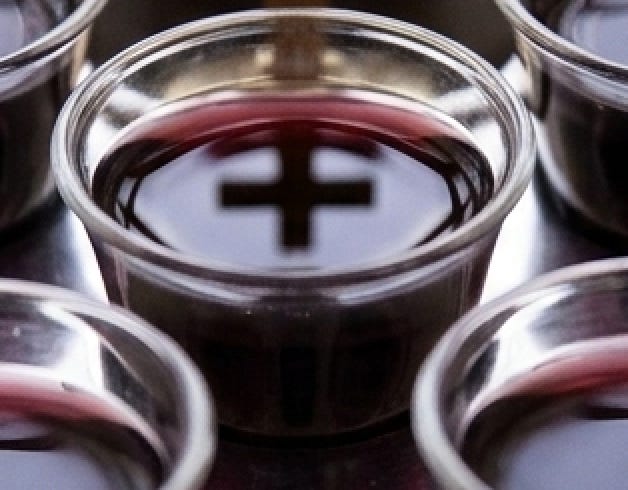
And second, the meal we eat and drink every Lord’s day includes the food and drink that he has commanded and shown us to eat and drink. The way that Paul states this in 1 Cor 11:27-28 is to call it “the bread” and, most notably, “the cup of the Lord.” This cup is not the cup because it is a single cup, but because the cup shows it represents the blood of the Lord and what it means to us.
“Whoever, therefore, eats the bread or drinks the cup of the Lord in an unworthy manner will be guilty concerning the body and blood of the Lord. Let a person examine himself, then, and so eat of the bread and drink of the cup.” (1 Corinthians 11:27-28)
We should examine ourselves because the cup of the Lord is both the blood of the Lord and the sacrifice and death of the Lord that caused him to bleed. The cup of the Lord requires reflection because it more than a drinking of grape juice, it is remembrance and acceptance and sharing in the faithful self-sacrifice that Jesus made on the cross. In his Gethsemane prayer, Jesus speaks of his coming suffering and death on the cross as the “cup” that he would have to drink, even though he did not want to drink it, but he would because he knew it was what the Father required of Him and it was what the world needed from him.
“And going a little farther he fell on his face and prayed, saying, “My Father, if it be possible, let this cup pass from me; nevertheless, not as I will, but as you will” . . . Again, for the second time, he went away and prayed, “My Father, if this cannot pass unless I drink it, your will be done.”” (Matthew 26:39, 42)
Likewise, we eat and drink of the supper as the Lord’s Supper, because we agree to and proclaim that we have died with Jesus and will continue to suffer and die with him both in denial of ourselves and rejection of a world in which we suffer because we are God’s children. Jesus cautioned his disciples during his life that he brought suffering and separation to his followers. And in Matthew 10:34-39 we read that this way of the Lord would require his followers to take up their crosses – not His cross – but their own sorts of suffering and death that rejected their decaying sinful lives in the world to find their true eternal lives.
““Do not think that I have come to bring peace to the earth. I have not come to bring peace, but a sword. For I have come to set a man against his father, and a daughter against her mother, and a daughter-in-law against her mother-in-law. And a person’s enemies will be those of his own household. Whoever loves father or mother more than me is not worthy of me, and whoever loves son or daughter more than me is not worthy of me. And whoever does not take his cross and follow me is not worthy of me. Whoever finds his life will lose it, and whoever loses his life for my sake will find it.” (Matthew 10:34-39)
So, this supper is the Lord’s Supper because in it we accept and adopt the life of our Lord, with all its suffering and death, because we know and proclaim that in the Lord’s death we have found God’s grace and life. It is the Lord’s cup that we drink, though there may be a part of us that doesn’t want it. And we do it self-sacrificially with sorrow over the death that was and is necessary. But we do it with thanksgiving and joy because our suffering brings hope of true life and knowledge of the true love of God.
Recently my family ate our daughters’ supper because we rejoiced in the love that we share because of their births. On every Sunday morning, I pray we eat and drink the Lord’s Supper, as the Scriptures teach, because we remember the love of God manifested in his Son’s death.
As enjoyable as the reading is, there some problematic statements. For one, the idea that Acts 20 was a) a decided upon waiting (So they could celebrate the Lord's Supper) and b) that the breaking of the bread HAS to mean the Lord's Supper. There are other reasons why the wait... For one, availability of travel mode. Also, the expression "Breaking bread" is also used in other places, where it is a "normal" meal. And then there is c) the we conclude form this passage that the "first day of the week was an established pattern by the time we come to Acts 20.
The next issue is establishing a "planned, weekly contribution for all sorts of use of the money (rent, salaries, mortgage etc.) The specified reason why Paul is collecting money was to help needy saints in Jerusalem. Not for any other "expenditures." The specified argument: Plan for this, so it will not be a surprise for you when I get there. And in a later letter Paul praises those who gave out of their extreme poverty, for the same cause: Needy saints in Jerusalem.
For a group who claims to "speak where the Bible speaks..." we sure say a lot NOT found in the Bible... ;-)